What you are moving to
Fort Collins is a home-rule city of 169,810 people at the 2020 census, the fourth most populous in Colorado, on the Cache la Poudre River where the plains meet the foothills, 60 miles north of Denver and the last city on I-25 before Wyoming. The City’s own overview puts the population at roughly 170,000 (2023, Census Bureau), the area at 58.1 square miles, the elevation at 5,000 feet, the sunshine at 300 days a year and the median age at 30.9, which is what a university in the middle of town does: Colorado State University enrolled a record 34,412 students in fall 2025. It grew from 143,986 in 2010 to 169,810 in 2020, and it is the city the towns around it run on: the school district reaches Timnath, Wellington, Laporte and Red Feather, the fire authority covers 230 square miles, and the buses run to Loveland, Longmont and Boulder.
The neighborhoods
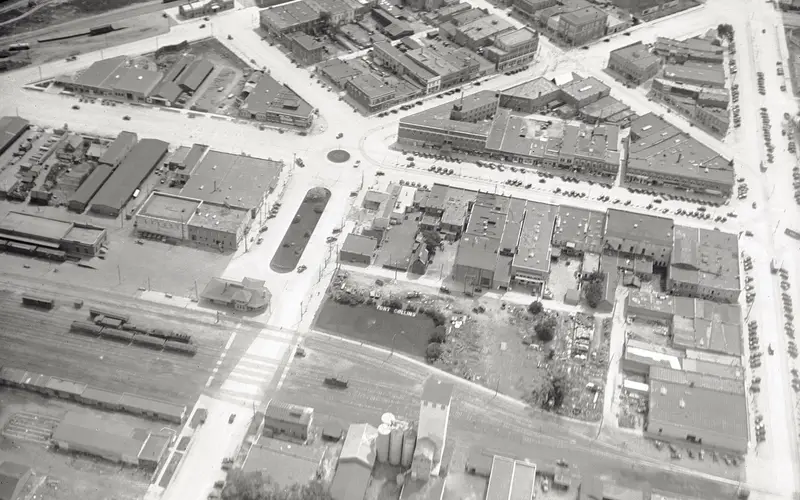
- Old Town is the original 1873 plat north of Mountain Avenue: a 26-acre National Register district of 1880s and 1900s brick around Old Town Square and Linden Street, a local historic district since 1979, the breweries on Linden and Lincoln, the Museum of Discovery, the Downtown Transit Center and the older houses on the grid around it. You get the restaurants, the music and the trolley at your door, and the smallest lots.
- Midtown is the three miles of College Avenue from Prospect Road south to Fairway Lane, with the MAX line down the Mason corridor behind it: a commercial strip of shopping centers and the Foothills mall site that the City’s Midtown Plan (2013) describes as active, car-oriented and lacking a distinct identity, with MAX stations at Prospect, Spring Creek, Drake, Swallow, Horsetooth, Troutman and Harmony. You get a MAX station within walking distance and the middle of the city.
- Campus is Colorado State’s main campus, between Laurel Street and Prospect Road west of College Avenue: the Oval and the Admissions building at its north end, the Lory Student Center at its center, Moby Arena on Plum Street to the north-west, Canvas Stadium on the south edge between Pitkin and Lake, and the University Center for the Arts a block east of College on Remington Street. See Colorado State for visitors.
- Campus West is the commercial district on West Elizabeth Street west of CSU, which the City’s West Central Area Plan (2015) calls the primary destination for eating and drinking near campus and intends as a “mini-downtown,” with the single-family neighborhoods south of Elizabeth behind it. You get CSU, City Park and the foothills trails close, and students for neighbors.
- North College is the highway strip north of the Poudre, from the river to the “Y” where College Avenue meets Highway 1, which the North College Corridor Plan (2007) describes as the northern entryway to the city, built ad hoc before city planning, a commercial corridor for commuters and travelers and the start of the Scenic Byway to the mountains; the City has been planning it since 1994. You get the river trail and a corridor the City is still remaking.
- Harmony is the five-mile corridor from the I-25 interchange west to the railroad, half a mile each side of Harmony Road, which the Harmony Corridor Plan (2006) calls the city’s southern entrance, the commuter route to Denver and one of its primary employment districts, carrying about 28,000 vehicles a day. You get the office parks, the Harmony Transfer Center where Bustang stops and the shortest drive to the interstate.
- South Fort Collins is everything between Harmony and the Loveland line: the subdivisions around Fossil Ridge High School, Fossil Creek Community Park and the Council Tree Library, with the Fossil Creek and Power trails, the Long View Trail into Loveland and the South Transit Center at the end of MAX. You get the trails and the transit center, and Loveland next door.
- The foothills are the west edge, where the streets run up to the hogback and stop at the City’s natural areas: Pineridge, Maxwell and Reservoir Ridge, linked by the 9.6-mile Foothills Trail, with Horsetooth Reservoir over the ridge. You get the views and the trailheads, and the longest drive to I-25.
Housing
The City’s Housing Strategic Plan of March 2021 is the plainest statement of the market. It says that since 2010 rents rose 68 percent, the median sale price of a single-family detached home rose 124 percent, from about $200,000 to $448,250, and the median for a townhome or condominium rose 164 percent, from about $120,000 to $316,885 (Fort Collins Board of Realtors, December 2020), while wages rose 25 percent; that nearly 60 percent of renters and 20 percent of homeowners are cost-burdened, spending more than 30 percent of income on housing; that the city is now almost evenly split between renters and owners; and that affordable units were 5 percent of the 70,692 homes in the city against a Council goal, set in 2015, of 10 percent by 2040. The overview counts 74,558 housing units and a median household income of $85,070 (2024). The listings sites in the sidebar show what is for sale; prices have moved since the plan’s figures, so take them as the shape of the market rather than the number. Ask whether a house is inside the City’s water service area or in a water district, which changes who bills you (below).
Schools
Fort Collins is in the Poudre School District, based at 2407 LaPorte Avenue, which teaches about 28,000 students across more than 1,800 square miles, from the city to Laporte, Loveland, Timnath, Wellington, Red Feather, Livermore, Stove Prairie and parts of Windsor: 31 elementary schools, 8 middle schools, 2 middle-high schools, 4 comprehensive high schools, 2 alternative high schools, 2 K-12 schools and 5 charter schools. The four comprehensive high schools are Fort Collins, Poudre, Rocky Mountain and Fossil Ridge, each fed by its own middle and elementary schools. The district’s calendars page has the year’s dates: in 2026–27 there is no school on November 23 to 27 or from December 21 through January 4, and students are back on Tuesday, January 5. Every address has a neighborhood school, and a student enrolled there rolls over each year without paperwork; to attend any other school, or a choice-only school, you file a School Choice application. First-round applications for 2027–28 open at 8 am on Monday, November 30, and close at 4 pm on Wednesday, December 16, after the district delayed the opening; a lottery sets the order within each priority ranking, and seat offers start the week of January 3, 2027. A second round opens in mid-January 2027. The district’s choice office is at 970-490-3203.
Getting around
Transfort is the City’s bus system and it has been fare-free on every route since the pandemic, a decision the City Manager made permanent in October 2024. Its spine is MAX, the bus rapid transit line on the Mason corridor with 12 stations between the Downtown Transit Center at 250 North Mason Street and the South Transit Center at 4915 Fossil Boulevard, linking Old Town, CSU and Midtown, partly on its own guideway; around it runs a network of local routes, redesigned in August 2026, including FLEX, the regional route to Loveland, Longmont and Boulder; the current map is on Transfort’s site. Bustang, CDOT’s interregional express bus, runs its North Line every day, on weekday, weekend and holiday timetables, from the Downtown Transit Center and the Harmony Transfer Center at 4414 East Harmony Road to Loveland, Berthoud, Firestone-Longmont and Denver Union Station, with wifi, restrooms and bike racks. By car, I-25 is the east edge of the city and the Harmony interchange is the route to Denver; Visit Fort Collins puts downtown Denver and Denver International Airport each at about an hour, and Cheyenne, Boulder and Estes Park at under an hour. Off the road, the City’s paved trails run 12.3 miles along the Poudre, 6.6 miles along Spring Creek, 8.5 along Fossil Creek, 4.6 beside MAX on the Mason Trail and 4 down Shields Street into Loveland, and the City publishes bike maps.
Utilities, trash, fire, police
- Electricity, water, wastewater and stormwater are Fort Collins Utilities, owned by the City, serving more than 75,000 customers; a new customer starts service by phone, at 970-212-2900, and the customer support page has the rest. Utilities supplies water, from the upper Poudre and Horsetooth Reservoir, to about 75 percent of addresses inside the city limits; the rest are in the Fort Collins-Loveland Water District or the East Larimer County Water District, so ask before you sign.
- Internet is Connexion, the City’s own fiber network: symmetrical 1-gig, 2-gig and 10-gig plans at $70, $100 and $200 a month, no contract, free installation, with phone and TV options, also at 970-212-2900.
- Trash, recycling and yard waste are collected under a City contract with Republic Services that began September 30, 2024, for single-family homes and buildings of seven or fewer units inside the city. You pick a cart size and pay by the month, from $11.41 for a 35-gallon cart every other week to $56.82 for a 95-gallon cart weekly; weekly recycling, yard trimmings from April to November and two bulk pickups a year are included. Sign up with Republic at 970-416-2012. Apartments and larger buildings arrange their own.
- Police is Fort Collins Police Services, 236 sworn officers and 145 civilian staff under Chief Jeff Swoboda, at 2221 South Timberline Road; non-emergency 970-419-3273.
- Fire and emergency medical response is the Poudre Fire Authority, a separate authority with, the City says, almost 200 firefighters and 13 stations covering 230 square miles in and around the city.
- Library is the Poudre River Public Library District, with three branches: Old Town at 201 Peterson Street, Harmony at 4616 South Shields Street and Council Tree at 2733 Council Tree Avenue; 970-221-6740.
Hospital, cars, pets and snow
- Hospital and emergency care: UCHealth Poudre Valley Hospital, 1024 South Lemay Avenue, has emergency care and is open around the clock; the main line is 970-495-7000.
- Registering a car is Larimer County’s job, at its Fort Collins vehicle licensing office, 200 West Oak Street, first floor, Monday to Friday 8 am to 5 pm except holidays; 970-498-7878. Book an in-person visit at larimer.gov/bookatime.
- Pet licenses: every dog and cat four months and older in Fort Collins needs one, renewed each year, from NOCO Humane: $17 a year for a spayed or neutered animal and $60 for one that is not; 970-226-3647 ext. 2010. NOCO Humane is also the City’s Animal Protection & Control, out from 8 am to 8 pm on weekdays and 8 am to 6 pm on weekends; 970-226-3647 ext. 7.
- Snow: you clear the sidewalk beside your property within 24 hours after a snowfall, the City’s snow removal rule. Plows take the major roads first, then the collector streets, then school zones and bus routes; residential streets are plowed only if they are blocked or in an emergency, and the same page has the City’s live plow map. Report an unshoveled sidewalk to Neighborhood Services at 970-224-6046 or online through Access Fort Collins, which takes the City’s other service requests too.
Pools, ice and rec centers
The City’s indoor centers are open all year. EPIC, the Edora Pool Ice Center at 1801 Riverside Avenue, has a 25-yard lap pool, diving boards and ice for public skating, open 5:30 am to 8 pm on weekdays and 8 am to 5 pm on weekends; public skating is $10 for adults and $8 for youth and seniors who live in the city ($12 and $10 for everyone else), skate rental $3; 970-221-6683. Mulberry Pool, 424 West Mulberry Street, opens at 5:30 am on weekdays, closing at 8 pm on Mondays, Wednesdays and Fridays and at 4:30 pm on Tuesdays and Thursdays, with afternoon swims on the weekend. Northside Aztlan Community Center, 112 East Willow Street, has a gym, an indoor track and fitness rooms, 6 am to 9 pm on weekdays and 8 am to 5 pm on weekends; 970-221-6256. The Fort Collins Senior Center, 1200 Raintree Drive, has a lap pool and hot tub, a gym, an indoor track, a woodworking shop and a library, open 6 am to 9 pm on weekdays and 8 am to 5 pm on weekends; its programs are aimed at adults 50 and older, it is open to anyone 18 and older, and it opens to every age on January 1, 2027; 970-221-6644.
Government
Fort Collins adopted its home-rule charter in October 1954, under Article XX of the state constitution, and has had a council-manager government since. The City Council is six members elected by district to four-year terms, limited to two, and a mayor elected at large to a two-year term, limited to three; the mayor is Emily Francis. Council holds its regular meetings on the first and third Tuesdays of each month at 6 pm in the Council Chambers at City Hall, 300 Laporte Avenue, streamed and archived on FCTV, with public comment for anyone who signs up by 5:30; work sessions are the second and fourth Tuesdays at 6, open to watch but not to speak. The City Manager, Kelly DiMartino since June 2022, runs the operation of about 2,500 employees, and Fort Collins Utilities, Transfort, the Gardens and the parks are City operations, with the Museum of Discovery a partnership between the City and a nonprofit.
Living here
Summer is the fare-free buses to the Independence Day celebration at City Park, the lazy river at City Park Pool from late May, the swim beaches at Horsetooth from Memorial Day weekend, the trolley on Mountain Avenue every weekend from May to September and concerts at the Gardens on Spring Creek. Fall is Pumpkins on Parade at the Gardens in late October and the first storytime term at the libraries. Winter is the Garden of Lights, and spring is the plant sale. Year-round there are the breweries that started it, Odell in 1989 and New Belgium in 1991, the Museum of Discovery with its free rooftop deck, and 29 miles of trail at Horsetooth Mountain for $10 a car. What is on this week is on the events page.