Music
Residency Concert w/ Stray Harbor + Friends
6 pm – 8 pm · Wolverine Farm Publick House, 316 Willow St.
History
A cavalry camp moved out of a flood in 1864, a town incorporated in 1873, a college that became CSU, a sugar factory, a streetcar, a liquor ban from 1896 to 1969, an Old Town on the National Register and the breweries. The short history of Fort Collins, each claim resting on a source.
· Checked November 10, 2026
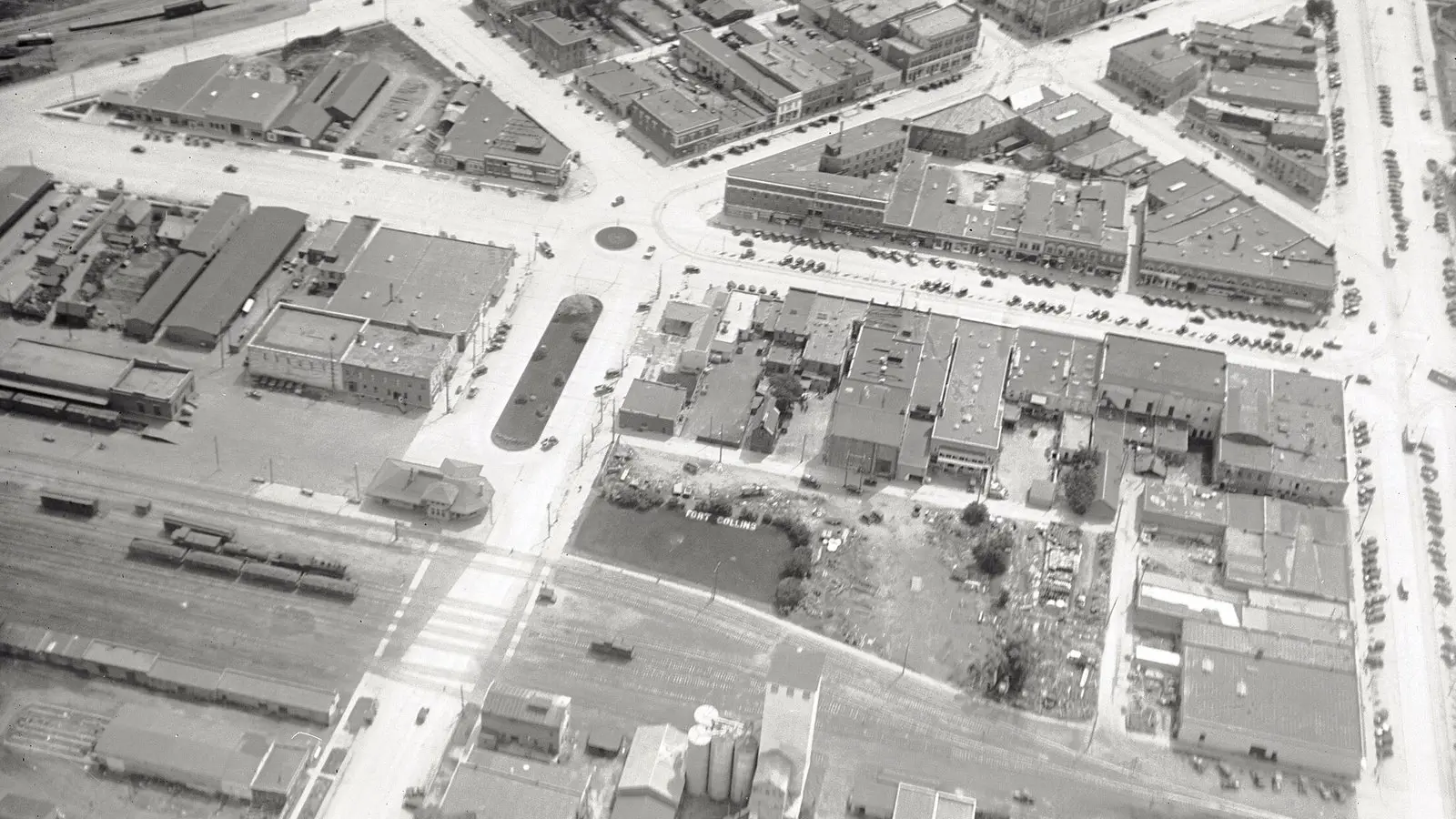
Fort Collins begins with a flood. In 1862 soldiers were sent from Fort Laramie to what is now Laporte to protect the Cherokee Trail and guard the Overland Stage Line, and the post was named Camp Collins after Lt. Col. William O. Collins, the commander at Fort Laramie. A flood in June 1864 destroyed the camp, and on August 20, 1864, Collins signed the order setting aside the present site, on higher ground beside the Cache la Poudre, as the new military reservation; the Fort Collins Historical Society keeps August 20 as the city’s birthday. The last soldiers left in September 1866. The settlers stayed.
The first boom came in 1872 with an agricultural colony, and on February 3, 1873, Fort Collins was incorporated as a town. The same year brought the first newspaper, the Larimer County Express, a town government and the plat whose grid is still Old Town. (Wikipedia’s lead gives February 12, 1883 as the incorporation date; the City’s own history says 1873, its time line records the 1873 election, and this article follows the City.) The Colorado Central Railroad arrived on October 8, 1877, chugging down Mason Street, where the tracks still run. The Colorado Agricultural College had been founded on paper in 1870; the cornerstone of Old Main was laid in 1878 and the first classes were held in the fall of 1879. It was renamed the Colorado State College of Agriculture and Mechanic Arts in 1935 and became Colorado State University by act of the legislature on May 1, 1957. The census counted 1,356 people in 1880 and 2,011 in 1890.
In 1896 the town went dry. Colorado women had won the vote in 1893, Fort Collins elected an alderwoman and an anti-license council in 1895, and an ordinance passed in 1896 ended liquor licenses; when Frank Miller’s license for his saloon on Linden expired on June 11, 1896, it ended the sale of liquor within the town. Carrie Nation spoke at the opera house in 1906, the anti-license party won the 1909 town election, and the city voted to stay dry in 1961 and rejected whisky and wine again in 1965. The end came from the campus: a 1968 referendum backed by students, a 3.2 beer license for CSU in March 1969, and on April 8, 1969, a vote of 4,853 to 2,691 for liquor sales on a 78 percent turnout. The first legal drink of spirits in Fort Collins since 1896 was served at about 5 pm on August 8, 1969.
Loveland got its sugar factory in 1901, and a company of Fort Collins businessmen built one of their own on Vine, north of the river between November 1902 and late 1903, at a cost of $1.25 million. It sliced its first beets in January 1904, and the Great Western Sugar Company bought it that summer. Its first-year payroll was three times all the other manufacturing payrolls in the area combined, the German-Russian families recruited from Kansas and Nebraska to work the beets, and the Hispanic families who followed, settled in Buckingham Place and Andersonville across the river, and the town grew from about 3,000 people in 1900 to 8,210 at the 1910 census and 11,489 by 1930. The Denver and Interurban’s streetcar line, franchised in 1906, opened in 1907 with three legs from Mountain and College: west along Mountain Avenue, south to Pitkin, and northeast on Linden toward the Lindenmeier Lake resort. Its Birney cars ran a 6.2-mile network until 1951, when the automobile and the suburbs had made them obsolete. The sugar factory outlived the streetcar by only a few years: in the mid-1950s Great Western announced it would not reopen the Fort Collins plant for the next campaign, and it never did.
In October 1954 voters adopted a home-rule charter, 2,133 to 1,834, under Article XX of the Colorado Constitution, creating the council-manager government the city still has and expanding the council from three members to five. The city doubled in size between 1944 and 1959 on the postwar building boom and the annexation of the CSU campus. Old Town, meanwhile, had been left behind by the growth to the south, which is why it survived. The Old Town Fort Collins historic district, 26 acres roughly bounded by College Avenue, Mountain Avenue, Pine, Willow and Walnut, with 38 contributing buildings in Late Victorian and Romanesque Revival styles including the Avery Block (1880 to 1897) and the Northern Hotel (1905), was listed on the National Register of Historic Places on August 2, 1978; the City made it a local historic district by ordinance in 1979. Mitchell and Company of Denver unveiled plans in 1981 to renovate Old Town as a business district with the Downtown Development Authority funding Old Town Square on Linden, and the restoration began in 1984. Fort Collins is known as one of the towns that inspired the design of Main Street, U.S.A. at the Disney parks; Visit Fort Collins says the historic strip on Walnut Street and an old firehouse served as the inspiration.
Anheuser-Busch opened its brewery northeast of the city on I-25 in 1988, and the next year brought the city’s first brewpub, CooperSmith’s, and its first craft brewery: Doug, Wynne and Corkie Odell opened Odell Brewing in 1989 in a 1915 grain elevator a few blocks from the brewery’s present home on East Lincoln Avenue. Kim Jordan and Jeff Lebesch founded New Belgium in 1991 in their Fort Collins basement after a bicycle trip through Belgium; Fat Tire and Abbey were first sold at the Colorado Brewers’ Festival in June 1991, and the brewery moved to Linden Street in October 1995. (The City’s time line dates the openings to 1990 and 1992; the breweries’ own accounts are used here.) Wikipedia counts more than 20 breweries in the city today.
The 1990 census counted 87,758 people; the city passed 100,000 in 1995; and the Spring Creek flood of July 28, 1997, when about twelve inches of rain fell, devastated the CSU campus, though flood mitigation was credited with saving an estimated 98 lives. The census counted 118,652 in 2000, 143,986 in 2010 and 169,810 in 2020, which makes Fort Collins the fourth most populous city in Colorado; the Census Bureau’s 2024 estimate was 170,924. CSU, the college that opened with one building in 1879, enrolled a record 34,412 students in the fall of 2025.
Music
6 pm – 8 pm · Wolverine Farm Publick House, 316 Willow St.