History
Niwot, Colorado history: the railroad town that never incorporated
Niwot was platted on March 30, 1875, on both sides of the Colorado Central tracks and named for the Arapaho leader Niwot, or Left Hand. The Diagonal Highway took its west side in 1958 and 1959, Second Avenue became a county historic district in 1993, and in 2026 voters kept Niwot unincorporated.
· Updated November 15, 2026 · Checked November 14, 2026
In this article · 8
On March 30, 1875, Porter T. Hinman and Ambrose S. Murray filed the plat of a new town with Boulder County, the Left Hand Valley Courier has reported. It lay on both sides of the new Colorado Central Railroad, halfway between Boulder and Longmont, and it was named for the Arapaho leader Niwot, who had been mortally wounded at Sand Creek eleven years before.
That filing still shapes the town. The streets run at an angle because they follow the tracks, and the business district sits on one side of the rails.
More than 150 years later, Niwot has never incorporated as a town.
Chief Niwot, or Left Hand
Niwot is the Arapaho name of the leader English speakers called Left Hand. Arapaho names often describe the person, and he was most likely left-handed, the Colorado Encyclopedia says. His name runs across the county: Left Hand Creek, Left Hand Canyon, Niwot Ridge and Niwot Mountain all honor him, Visit Longmont notes.
He was born in the 1820s, and his band spent its winters around Boulder. By the encyclopedia’s account, he learned English as a boy from John Poisal, a trader who married his sister, and worked as an interpreter. The 1851 Fort Laramie Treaty recognized the Boulder and St. Vrain valleys as Arapaho and Cheyenne territory, the Niwot Historical Society’s timeline records.
When gold seekers poured into the region in 1858 and 1859, Niwot argued for peace. He met with territorial governor John Evans, and in 1864 he helped ransom white captives alongside the Cheyenne leader Black Kettle.
The line known as Niwot’s curse, that people who see the valley’s beauty will stay and their staying will undo it, is local legend.
Sand Creek, 1864
On November 29, 1864, Niwot, Black Kettle, White Antelope and about 750 Arapaho and Cheyenne people were camped on Big Sandy Creek when Colorado volunteer troops under Colonel John Chivington attacked. About 230 people were killed, most of them women, children and elders, according to the National Park Service. Niwot was mortally wounded and died within days.
The town that carries his name was platted eleven years later. At a talk at Niwot Hall in March 2025, Chester Whiteman of the Cheyenne Tribe told the audience, “We never came back to this area after 1864,” the Left Hand Valley Courier reported.
Niwot is one of three figures in Peace Keepers, the Sand Creek Massacre memorial that a 2025 joint resolution of the Colorado General Assembly approved for the west grounds of the State Capitol in Denver. Its first statue, of Black Kettle, was unveiled at the History Colorado Center in October 2026, the Colorado Sun reported. Representatives of the Cheyenne and Arapaho Tribes of Oklahoma, the Northern Arapaho Tribe and the Northern Cheyenne Tribe dedicate the Capitol site on November 29, 2026, the 162nd anniversary of the massacre, the Sand Creek Massacre Foundation announced.
A section house on the new railroad
The Colorado Central Railroad reached Boulder from Golden in 1873 and by that fall ran twelve miles on to Longmont, Anne Dyni writes. Halfway along stood a section house, the base for the crew that kept up the track. A depot opened there the same year, with George W. Wilson as its first agent, according to the Historical Society.
Hinman had come to the area in 1860, and Murray was a Boulder resident. Each gave 20 acres just north of the section house for the town, Dyni writes in Around Niwot. Their plat laid out streets, alleys and lots on both sides of the tracks, on a grid set at an angle to follow the rails.
The town was built for shipping. From the depot, farmers sent cattle to the Denver stockyards and produce to Boulder and Longmont. Left Hand Grange No. 9, the farmers’ organization that still meets in Niwot, was organized in December 1873, the Courier has reported.
Second Avenue and the sugar beet years
Niwot’s first business district stood west of the tracks: a blacksmith shop, a feed mill and general stores behind the depot and its loading pens, the Niwot Business Association’s history says. Most homes were on the east side.
After 1900 the stores moved east to Second Avenue. John Nelson, a Swedish-born wagon maker who turned to building as cars replaced wagons, finished Nelson Hall at Second Avenue and Franklin Street in 1907, with a store downstairs and a meeting hall upstairs, the Historical Society’s walking tour notes. The Grange bought the hall from his estate in 1945. It was renamed Niwot Hall in 2024, and the Grange still meets there, the Courier reported.
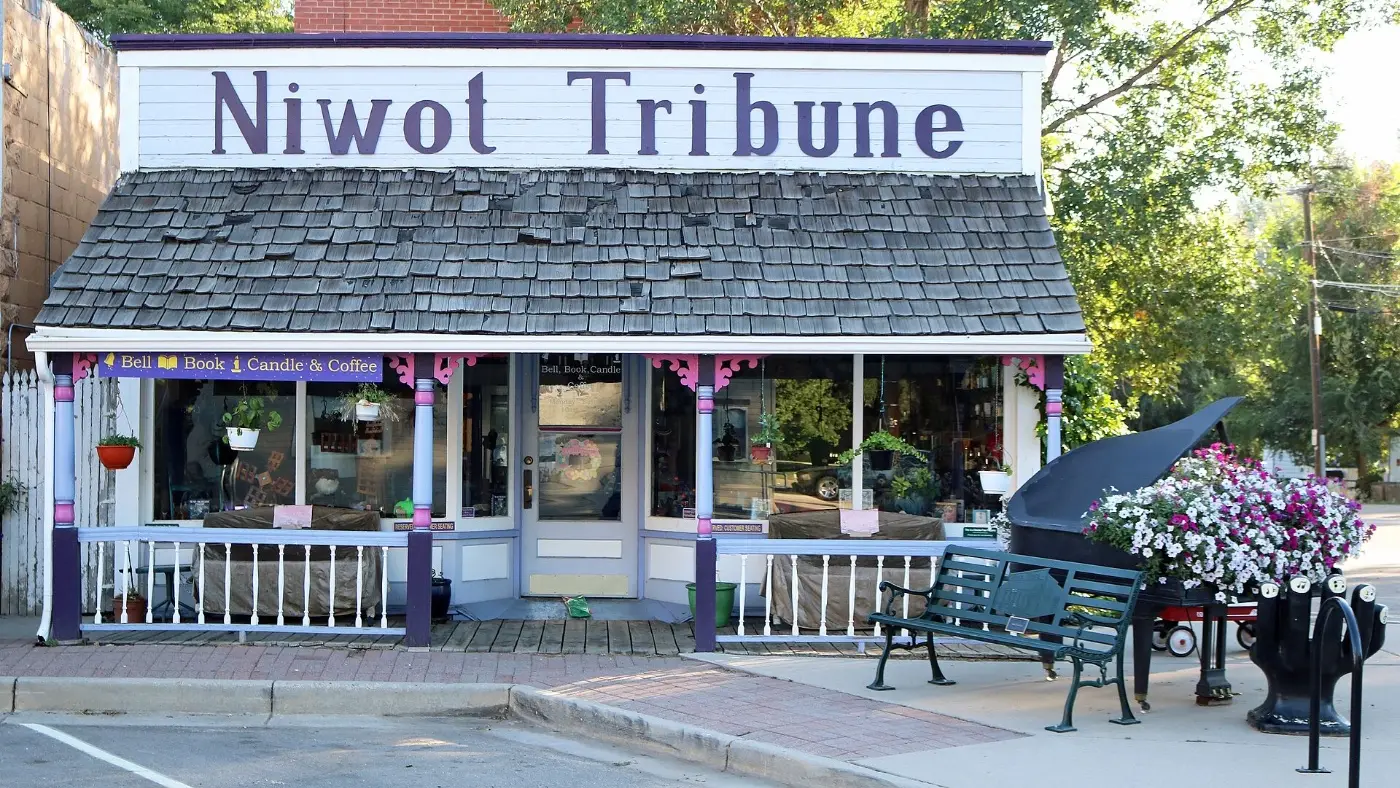
Most of the first block was complete by 1915. The weekly Niwot Tribune printed its first issue in August 1921, according to the Society’s Tribune collection.
Sugar beets arrived in 1903. In 1916 the Great Western Sugar Company built a ramp on Murray Street, across from the depot, where horses hauled loaded wagons to the top and farmers tipped the beets straight into open railcars.
In 1914 local fans asked the Northern Colorado Baseball League to add a Niwot Farmers team. By 1946 Niwot had about 200 residents, the Society’s timeline records.
The trains stop, and the Diagonal takes the west side
Trains stopped calling at Niwot for passengers, freight and mail in 1932. The passenger half of the depot came down in 1943, and the rest was gone by 1958, the Society’s history of the depot says.
The Diagonal Highway between Boulder and Longmont was built along the tracks, and it took the old west side of town. Hinman Street was removed starting in 1958, the Courier reported. By 1959, when construction began, every building left west of the tracks had been razed or moved, the walking tour says.
The depot and the old brick elementary school went in the same decade, and none of the original west-side businesses survived, Dyni writes.
Water, IBM and a protected main street
In 1961 the Left Hand Water Company, now the Left Hand Water District, formed to deal with wells and cisterns contaminated by septic systems. The IBM plant that came to the area in 1965 brought workers and new homes, and the Niwot Sanitation District followed, the Courier has reported.
In late 1992, property owners and residents of Old Town and Cottonwood Square approved a half-cent sales tax for drainage, sidewalks and street lights, and Boulder County covered a third of the $757,000 cost, according to the Courier.
In 1993 the Boulder County commissioners created the Niwot Historic District, protecting eight commercial buildings on Second Avenue and one house on Franklin Street. Changes to those buildings go through a Design Review Committee the commissioners appoint.
Why Niwot has no town hall
The 1875 plat made Niwot a town on the map, but it was never incorporated under state law. The Census Bureau counts it as a census-designated place, with 4,306 residents in 2020, its profile of Niwot shows. Boulder County governs it, and Who runs what in Niwot lists the county offices and districts behind each service.
On November 3, 2026, voters inside the proposed town boundary rejected incorporation by nearly three to one, Boulder County’s election results show. The election guide has the full results.
Visit these places
- Second Avenue, from Murray Street to Franklin Street: the first block of the 1993 historic district. Old Town on this guide.
- The Historical Society’s walking tour: a self-guided map of the historic district, building by building. Walking tour.
- Niwot Hall, at 195 Second Avenue: John Nelson’s 1907 hall. Niwot Hall on this guide.
- Old Fire House Museum, beside Niwot Hall: the town’s 1910 fire shed, rebuilt there. Museum page; check the Historical Society’s site before visiting.
- Whistle Stop Park, at Murray Street and First Avenue: CB&Q caboose 14649, built in 1907 and donated in 2003 by the Boulder County Railroad Historical Society. Park page.
- Murray Street and the Hinman Ditch: the two founders’ names, still on the map.
- The Diagonal Highway: the strip where the west side of town stood.
More on the town: Niwot.
Finish signing up in the new tab, then confirm by email.
Buttondown’s page asks you to press “Verify and Subscribe”, then sends an email with a link to confirm. If the tab did not open, or it shows an error, open it again or change your details.
What’s new in Niwot
Related
- Old Town, Second Avenue
The first block of the 1993 historic district, still where the community gathers.
- Old Fire House Museum
The 1910 fire shed and chemical fire cart the Historical Society keeps beside Niwot Hall.
- The 2026 Niwot incorporation election, plainly
What the November 2026 ballot asked about becoming a town, and the count.