Golden, Jefferson County · History
Golden: gold rush, brewery, and School of Mines
Ute, Arapaho and Cheyenne homeland, Golden City in 1859, a territorial capital that moved to Denver in 1867, the Colorado Central, Coors, the School of Mines, Buffalo Bill's grave, a solar lab and a town that kept its old buildings. The short history of Golden, with sources.
· Updated November 17, 2026 · Checked November 17, 2026
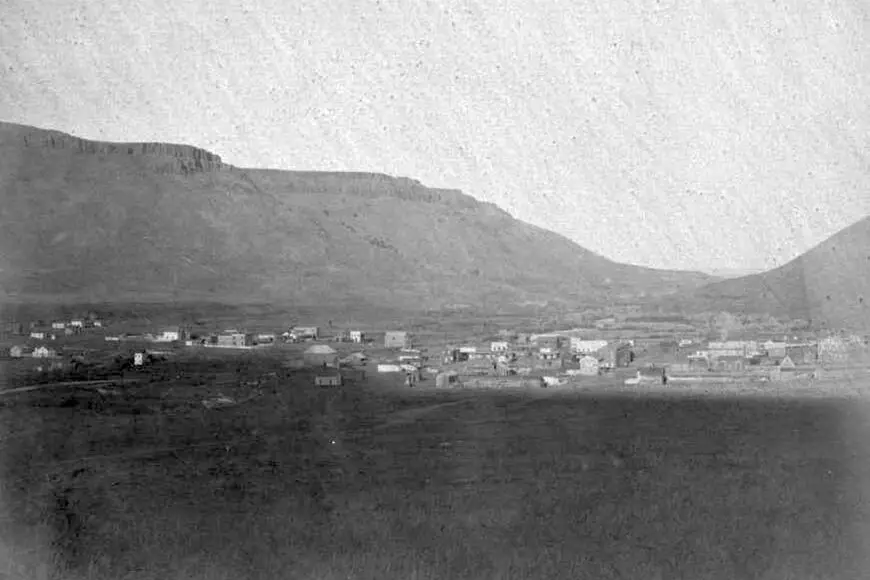
Golden grew up where Clear Creek comes out of the foothills, on what the City’s history museum calls an access corridor between the Rocky Mountains and the Plains. It began as a supply town for the 1859 gold rush, was for a few years the capital of Colorado Territory, and lost both the capital and the railroad race to Denver. What it kept was industry and a college: a brewery that grew into the largest at a single site in the world, the Colorado School of Mines, and, a century later, a federal energy laboratory. This is the short version, from the sources listed at the foot; where they disagree, both are given.
Before Golden City
The Golden History Museum, which the City runs, says Native American history in the Clear Creek Valley and on the table lands of the Front Range goes back more than 12,000 years; in a 2024 update its director wrote that evidence from the Magic Mountain Archaeological Site in Golden shows people living here for more than 10,000 years, with Indigenous knowledge pointing to a longer presence. The museum’s 2022 ethnographic study, made with cultural advisers from six tribes, places the area within the origin places of the Moghwachi, Tabeguache and Uncompahgre bands in Ute oral history and dates the Cheyenne and Arapaho history of the Front Range to the eighteenth century. It ties the town’s founding to painful histories: the forced removal of the Utes from much of their land, and of the Cheyenne and Arapaho from Colorado after the Sand Creek Massacre.
Since 2024 a Native American Arbor, built of juniper posts cut near Ignacio and facing due east, has stood in Golden History Park, an idea that came from the museum’s Native American Advisory Board.
Golden City, 1859
Golden City was established on 16 June 1859 along Clear Creek and named for Thomas L. Golden, Wikipedia records; the City says he was a gold prospector who had arrived in Jefferson County in 1858, and Mines’ own history calls the town a supply center for miners and settlers. George West came that year with the Boston Company, part of the group that built Golden’s first building, a trading post beside Clear Creek, and edited the company’s newspaper, the Western Mountaineer, the City’s 12th Street Historic District tour says; in 1866 he founded the Colorado Transcript. Between July and December 1859 William Loveland built Golden’s first storefront, of logs and cut boards, at 1105 Washington Avenue, with his store downstairs and a public hall above, where Golden’s first Christmas was celebrated and Colorado’s first Masonic lodge was organized, the Golden Landmarks Association says.
The capital
By the end of 1860, Wikipedia says, Golden City was the seat of Jefferson County and the capital of the provisional Jefferson Territory. It became the capital of Colorado Territory in 1862, the City says. Wikipedia dates that to 2 August 1862 and adds that by the mid-1860s the title was largely honorific, with the governor living in Denver and the legislature often meeting there, though the territorial supreme court sat in Golden.
The legislatures met in Loveland’s buildings. Both the Jefferson and the Colorado territorial legislatures sat in the hall above his first store, the Landmarks Association says. In 1866 the Colorado legislature moved to the Loveland Block at 1122 Washington Avenue, which he had built in 1863 and enlarged that year in answer to Denver papers complaining that Golden housed the legislature in vacant stores and barns; it met there for only a couple of months over 1866 and 1867, the association says. In 1867 the capital moved to Denver, about 12 miles east, Wikipedia records. The Loveland Block now houses the Old Capitol Grill.
Railroads, mills and a brewery
Loveland founded the Colorado Central Railroad on 9 February 1865 to tie Golden to the transcontinental line at Cheyenne, Wikipedia records. Denver’s voters backed bonds for the Denver Pacific, which got there first; by 1870 Golden had lost, and the Colorado Central turned west to Georgetown, Black Hawk and Central City, reaching Cheyenne only in 1877.
Astor House went up in 1867 as a hotel, of sandstone quarried at the west end of 12th Street, and was named after the Astor House in New York, the City’s survey of the Territorial Capital District records. For much of its life as a boarding house it was a dormitory for School of Mines students, says Foothills Art Center, which uses the building now. The State Demography Office’s census file gives 1871 as the year Golden incorporated and counts 2,730 people in 1880.
Adolph Coors and Jacob Schueler founded the brewery in 1873, its Wikipedia history records, and its flagship beer is usually described as Czech or Pilsner-style. It survived Prohibition, when it made malted milk and sold much of it to the Mars candy company, and grew into the largest single-site brewery in the world. Wikipedia calls the Golden of those decades the “Lowell of the West,” with flour mills, smelters, brick works, a paper mill and clay and coal mines. The fire department was founded in 1879, the City says, when three rival fire companies merged.
The School of Mines
Bishop George M. Randall arrived in the territory in 1866 planning a university with a school of mines, and in 1870 opened Jarvis Hall just south of town. The School of Mines opened under the Episcopal Church in 1873, became a territorial institution in 1874 and a state one in 1876, when Colorado became a state. It held its first commencement, for two graduates, in 1883, and graduated its first woman in 1898. Since 1908, when 250 students, 20 faculty and a team of burros first made the climb, new students have carried a rock from home up Mount Zion to the hillside “M.”
The twentieth century
Golden stayed small for a long time: 2,152 people in 1900 and 2,426 in 1930, by the census.
William F. “Buffalo Bill” Cody died in Denver in 1917 and was buried on Lookout Mountain on 3 June. His wife Louisa said it was his choice; the people of Cody, Wyoming, said he wanted to lie there instead, and the museum’s history answers that close friends and the priest who gave him last rites confirmed Lookout Mountain. His foster son Johnny Baker opened a museum beside the grave in 1921, in a building called Pahaska Tepee; Denver took over the collection after Olive Baker died in 1956, and the Buffalo Bill Museum and Grave moved into its present building in 1977, still part of Denver’s mountain parks.
In 1934 and 1935, 180 Depression-era relief workers paid in meals and $1 a week built a stone amphitheater for about 2,500 people at the National Guard’s Camp George West; it stands beside the T. rex Tooth Trail in South Table Mountain Park, on Department of Energy land with no public access. In 1938 residents began collecting Golden’s artifacts, and the county commissioners, with Works Progress Administration help, made the collection the basis of the Golden History Museum, which opened in January 1939 and has been at 923 10th Street since 1996.
Then Golden grew: 5,238 people in 1950 and 7,118 in 1960. In 1959, Wikipedia says, the town nearly tripled in area overnight by annexing land to the south that included the new Magic Mountain theme park. The museum’s Discover magazine adds that Magic Mountain and East Tincup, another Western theme park half a mile away on Colfax, both held grand openings in 1960 and both failed soon after. The Colorado Railroad Museum arrived at the same time: Robert W. Richardson moved his collection of narrow gauge equipment from Alamosa in 1958, and he and Cornelius Hauck opened the museum in Golden in 1959.
The next arrival came from Washington. The Solar Energy Research Institute, the first federal facility dedicated to developing solar power, opened on 5 July 1977, with Golden chosen as its home and a 300-acre site on South Table Mountain in the winning proposal; it became the National Renewable Energy Laboratory in 1991, and on 1 December 2025 the Department of Energy renamed it the National Laboratory of the Rockies.
Keeping the old town
Golden has kept much of its past. Astor House was bought by the Golden Downtown Improvement District in 1971 to make way for a parking lot, and on 13 June 1972 Golden voted to save it, 69 percent in favor, Wikipedia records; the Golden Landmarks Association was founded that year in response to the planned demolition. The City’s historic preservation program began in 1983 with the 12th Street district’s listing on the National Register, and there are now three locally designated districts: 8th and 9th Street, 12th Street and East Street. When a housing development threatened the Pearce Ranch in Golden Gate Canyon in the early 1990s, its cabins were moved to town log by log from 1994 and rebuilt over four years, and Golden History Park opened in the spring of 1999. It also holds the 1876 Guy Hill schoolhouse, moved to Golden in 1976.
The 2020 census counted 20,399 people. In 2026, the 150th year of statehood, the museum opened an exhibit called Glimpses of Golden, on the town’s story from territorial capital to its present fame as a science, technology and recreation hub.
Sources
- Golden History Museum & Park: Indigenous Connections, Native American Ethnographic Study (2022)
- Golden History Museum & Park: Indigenous Connections Project Update (2024)
- Golden History Museum & Park: Fall 2022 Discover magazine
- Golden History Museum & Park: Golden History Park
- Golden History Museum & Park: History Museum
- Golden History Museum & Park: Major Colorado and US Milestones (2026)
- Colorado School of Mines: History and Traditions
- City of Golden: Art, Culture & History
- City of Golden: 12th Street Historic District map tour
- City of Golden: Territorial Capital District Points map tour
- Golden Landmarks Association: Loveland Building (1860–1868)
- Golden Landmarks Association: Loveland Block (1863–1871)
- Golden Landmarks Association: About
- Foothills Art Center: Astor House history
- City of Golden: Historic Property Preservation
- City of Golden: Golden Fire Department, About Us
- Colorado Railroad Museum: History & Timeline
- Buffalo Bill Museum and Grave: Our History
- Buffalo Bill Museum and Grave: A Brief History of William F. "Buffalo Bill" Cody
- Jefferson County Parks & Open Space: South Table Mountain Park
- National Laboratory of the Rockies: History
- Colorado State Demography Office: historical census counts (CSV)
- Golden, Colorado on Wikipedia
- Astor House (Golden, Colorado) on Wikipedia
- Coors Brewing Company on Wikipedia
Checked November 17, 2026. Hours, prices and seasons change; the sources above are the record.
Related
- Golden History Museum
Free, Tuesday to Saturday, with 15,000-plus objects in the collection.
- Golden History Park
The 1800s cabins and 1876 schoolhouse moved to the creek downtown.
- Buffalo Bill Museum and Grave
Cody’s grave and museum on Lookout Mountain; the grave and the observation deck are free.